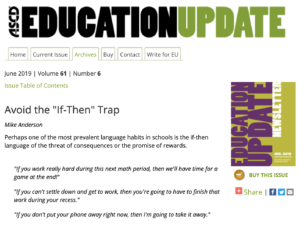
Avoid the “If-Then” Trap
We want students to be more than compliant, don’t we? In addition to doing the right things, we want them to do so for the right reasons. We want students to pick up trash to keep the room clean, to be kind to others because it makes them feel good, and to complete work on time to be responsible.
Yet one of the most prevalent language habits in schools is the “if-then” language of the promise of rewards or the threat of consequences. We accidentally send low-level moral reasoning for doing good when we rely on “if-then” language. So what should we say instead?
In this article, published in June 2019 in Education Update, I offer some suggestions! Click on the link below to read the article.
Author
-
A public school teacher for 15 years, Mike has also had many other roles in education: preschool aide, high school and age-group swim coach, camp counselor, graduate class instructor, and Responsive Classroom presenter and developer. He now works as a consultant, providing professional learning for teachers throughout the US and beyond.
As a classroom teacher, Mike was awarded a national Milken Educator Award and was a finalist for NH Teacher of the Year. In 2020, he was awarded the Outstanding Educational Leader Award by NHASCD for his work as a consultant. A best-selling author, Mike has written many books about great teaching and learning. His latest book is Hugging Porcupines: Month-by-Month Strategies to Support Our Most Challenging Students.
When not working, Mike can be found hanging with his family, tending his perennial gardens, sorting baseball cards and searching for new running routes around his home in Durham, NH.
View all posts
You may also like

Human Goodness on Display During the Nationwide Aviation Mess and a Take-Away for Educators
- November 16, 2026
- by Mike Anderson
- in Challenging Behaviors
Mae: The Ultimate Ted Lasso Warm Demander
Delayed Gratification