A friend and colleague of mine, Andy Dousis, once told me that every lesson has three moments: a golden one, a silver one, and a leaden one. Whatever you say in the first 60 seconds of the lesson is the
Walk through most schools, and you’ll see messages like the ones above, posted in classrooms and in hallways. We often encourage kids, as they’re about to work to “try your best” or “put in max effort.” One year in
What did the mathematical acorn say when he grew up?
“Ge-om-e-try!” (“Gee, I’m a tree!”)
Ah—dad jokes. Silly plays on words. Puns. Cornball humor. Eye-rollers. Groaners.
Ted Lasso is packed with goofy humor. Have you noticed how this keeps your
Do your students seem young this year? You’re not alone. In every single school I’m working in this year—with no exceptions—teachers are saying the same kinds of things.
This shouldn’t be surprising. Students always seem a bit young in the
“To weave the magic of a thing, you see, one must find its true name. In my lands we keep our true names hidden all our lives long, from all but those we trust utterly; for there is great power,
The last weeks of school are a tumultuous time of transition. Not all students look forward to summer vacation, and even ones who do are likely anxious about next year. For some students, next year brings a new school, not
Teacher language can be a great focus for a New Year’s resolution. After all, we all use language with students, and we all surely have some habits that could use some refinement. Often, some of our language habits don’t line
I was delighted to join a group of deep thinkers for an in-depth panel discussion about leaner-centered education. Hosted by Julie Mountcastle of the Slate School, this conversation is rich and engaging. You’ll hear about the importance of cherishing children’s
A Conversation with Mike Anderson, Little Things First
This is part 3 of a four-part series on how to support educators in the midst of the coronavirus pandemic.
In this conversation with the Little Things First podcast hosts, Tracy
You’ve spent the whole year building a community of learners. You’ve established rules and routines to help learners manage themselves and work well with each other. Now, with schoolwork potentially moving offsite, you still want to support your students as
A teacher recently wrote me an email asking for some advice about student motivation. She graciously agreed to let my answer morph into a blog post.
I just finished listening to your ASCD webinar about language. I found your presentation thoughtful,
What do you think–should teachers call students “friends”?
Educators at William H. Rowe School in Yarmouth, Maine are engaged in an exploration of teacher-talk. They’re using What We Say and How We Say It Matter: Teacher
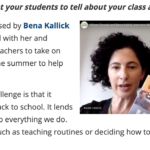
Tell a story that you would want your students to tell about your class at the end of the year.
This compelling challenge was posed by Bena Kallick on a recent video interview I had with her and Allison Zmuda.
If you teach reading and/or writing, there’s a good chance that when introducing a new concept or skill, you begin your lesson by saying some variation of, “Good readers….”
“Good readers pay attention to context clues.”
“Good writers add
One of the most deeply held beliefs of many educators is that we should praise students—a lot. Many of us were taught, early on in our careers, that the more we praise our students, the better they’ll feel, and the
Childhood anxiety is on the rise. According to research cited in a recent Washington Post article, the diagnosis of childhood anxiety in children ages 6-17 has jumped 20% in recent years.
The way we introduce learning options to students can make or break a choice experience for students. In this blog post, you’ll learn some practical strategies and ideas from Maggie West, a fifth-grade teacher in Conway, Massachusetts. To get
“If I give my students choice, I’m worried they’re going to make bad choices,” I often hear teachers say. “They’re just going to choose the easiest option. Or, they’re going to choose what their friends choose.”
There’s no doubt that
In survey after survey, business leaders are clear about what they’re looking for in employees. They want creative, dynamic, and independent thinkers. They want people who work well with a variety of people. And, importantly, they don’t want to hire
Many schools are working hard to help promote a growth mindset in their students. I recently facilitated a learning session with a group of teachers that I’d like to pass along. It is a simple activity that yielded some powerful
For a long time, when I wanted to give students positive feedback about their work or behavior, I began with some version of, “I like the way you…”
“Jeremy, I like the way you’re working so hard on that
Original Article: https://www.responsiveclassroom.org/blog/lecture-less
So we know students need to sit still to accomplish some school tasks, but we don’t want to keep them sitting for too long. How can we minimize the amount of time we require children to sit still?
Original Article: http://www.seacoastonline.com/article/20040208/NEWS/302089982
PORTSMOUTH — Like other teachers, Mike Anderson had one generic phrase to award students for good work when he taught at Flanders Elementary School in East Lyme, Conn.
“‘Great job!’ was mine,” said Anderson, now a fourth-grade teacher