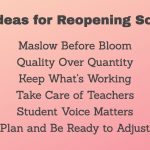
What might schools look like in the fall?
We can learn from schools that have already welcomed children back to school.
In the United States, many of us (teachers, parents, and students) are filled with anxiety about what the
This has been a spring that few of us anticipated. As we now look to the end of the year, many of us are aching for our favorite end-of-the-year moments—that final awesome read-aloud, the class gathering with families, the spring
A Conversation with Mike Anderson, Little Things First
This is part 3 of a four-part series on how to support educators in the midst of the coronavirus pandemic.
In this conversation with the Little Things First podcast hosts, Tracy
You’ve spent the whole year building a community of learners. You’ve established rules and routines to help learners manage themselves and work well with each other. Now, with schoolwork potentially moving offsite, you still want to support your students as
A school-based content coach wrote to me because her K-5 school is considering moving toward content specialization. This means that at each grade level, teachers would focus on specific content areas and kids would change classes throughout the day. She
A teacher recently reached out to me about PBIS (Positive Behavior Intervention & Supports) and reward systems. It’s a question I’ve been hearing a lot as I work with teachers across the United States.
I am in a district
A teacher recently wrote me an email asking for some advice about student motivation. She graciously agreed to let my answer morph into a blog post.
I just finished listening to your ASCD webinar about language. I found your presentation thoughtful,
Are incentive systems used in your school? Do kids get handed tickets or fake money (to be spent at the school store) for walking quietly in hallways? Are gem and marble jars used to motivate kids to raise their hands
We know about the power of relationships. We’ve heard (and believe!) the old adage, “Kids don’t care what you know until they know that you care.” So how do we build and cultivate those all-important relationships…with some of our toughest
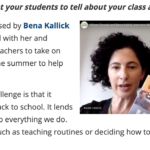
Tell a story that you would want your students to tell about your class at the end of the year.
This compelling challenge was posed by Bena Kallick on a recent video interview I had with her and Allison Zmuda.
If you teach reading and/or writing, there’s a good chance that when introducing a new concept or skill, you begin your lesson by saying some variation of, “Good readers….”
“Good readers pay attention to context clues.”
“Good writers add
As the school year winds down, it can be hard for students (and teachers) to keep their positive energy high. With the end in sight, it can be hard to stay motivated to do work. With worries about the end
One of the most deeply held beliefs of many educators is that we should praise students—a lot. Many of us were taught, early on in our careers, that the more we praise our students, the better they’ll feel, and the
This quote is one of my favorites. If you’ve attended a professional development session with me, there’s a good chance I’ve shared this with you at some point. It so clearly articulates the importance of
Childhood anxiety is on the rise. According to research cited in a recent Washington Post article, the diagnosis of childhood anxiety in children ages 6-17 has jumped 20% in recent years.
“If I give my students choice, I’m worried they’re going to make bad choices,” I often hear teachers say. “They’re just going to choose the easiest option. Or, they’re going to choose what their friends choose.”
There’s no doubt that
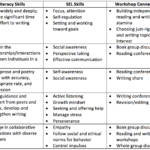
Social-emotional learning (SEL) is a hot topic in schools right now—as it should be. It’s increasingly clear that social and emotional skills are the keys to the kingdom—it’s the skill set that employers are seeking—the skill set that’s less likely to
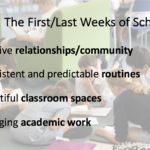
We all know the importance of the first six weeks of school. We build positive relationships with students and a strong sense of community membership within our classes. We establish consistent and predictable routines to help students feel safe and allow them
In survey after survey, business leaders are clear about what they’re looking for in employees. They want creative, dynamic, and independent thinkers. They want people who work well with a variety of people. And, importantly, they don’t want to hire
I wish I could teach social and emotional skills, but there’s too much pressure to teach academics—I just don’t have time!
As I work with teachers in schools across the United States, I often hear some version of this statement.
How Sharing Control of Learning with Students Makes Differentiation Better
Too often, differentiation (especially when it’s called differentiated instruction) places nearly all of the responsibility and work for differentiation in the teacher’s court. This often results in teachers feeling like
It’s now widely recognized that teachers must teach students the routines of the classroom. This is actually a shift. Years ago, it was often just assumed that kids should know how to walk respectfully in the halls, get supplies and
Note: This article first appeared on Learning Personalized in April, 2016: http://www.learningpersonalized.com/students-learn-choose-choose-learn/. Thanks go out to my friend and colleague, Allison Zmuda, who originally published the post!
I was recently working with a group of high school teachers, and they
Many schools are working hard to help promote a growth mindset in their students. I recently facilitated a learning session with a group of teachers that I’d like to pass along. It is a simple activity that yielded some powerful